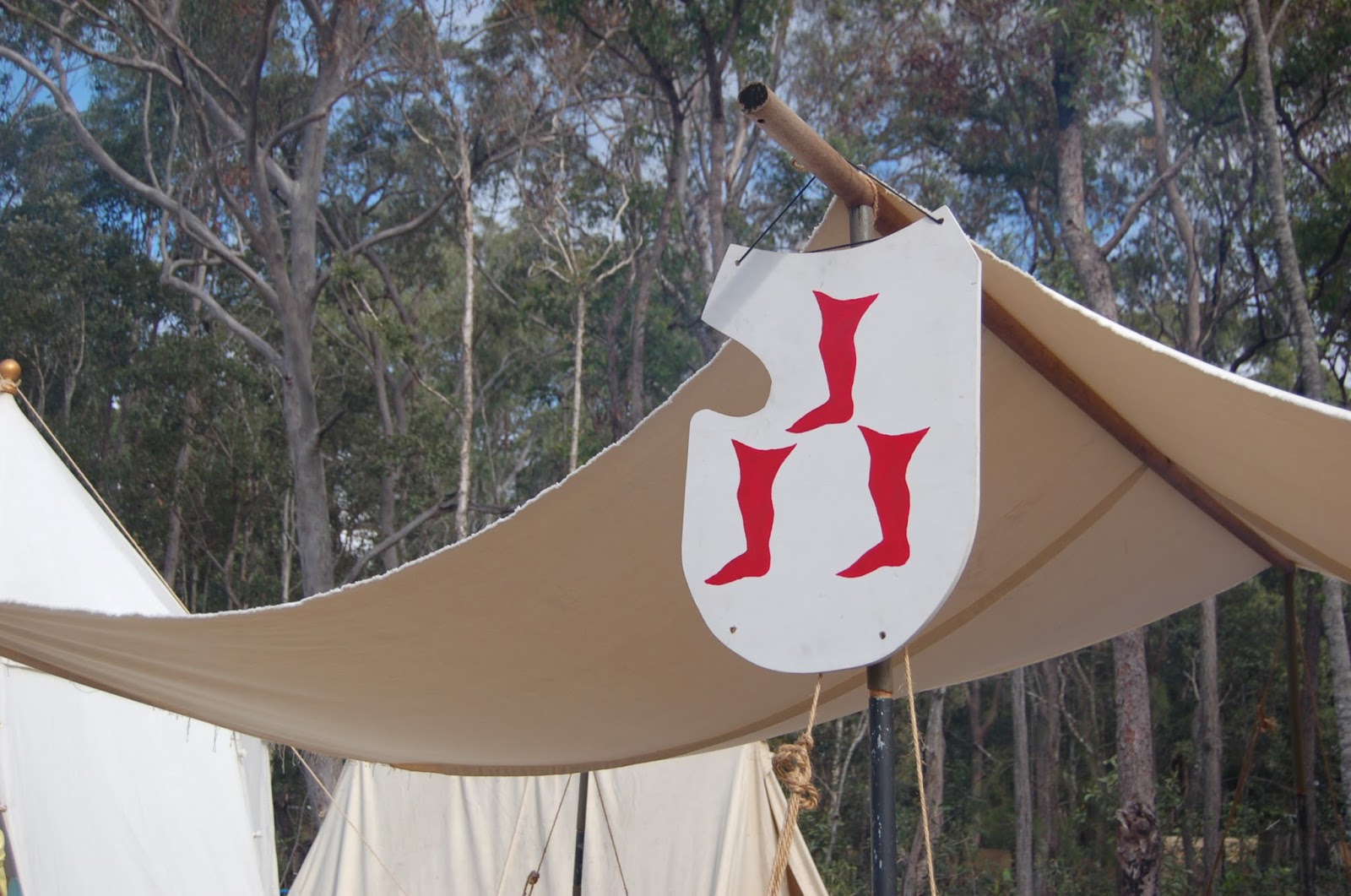
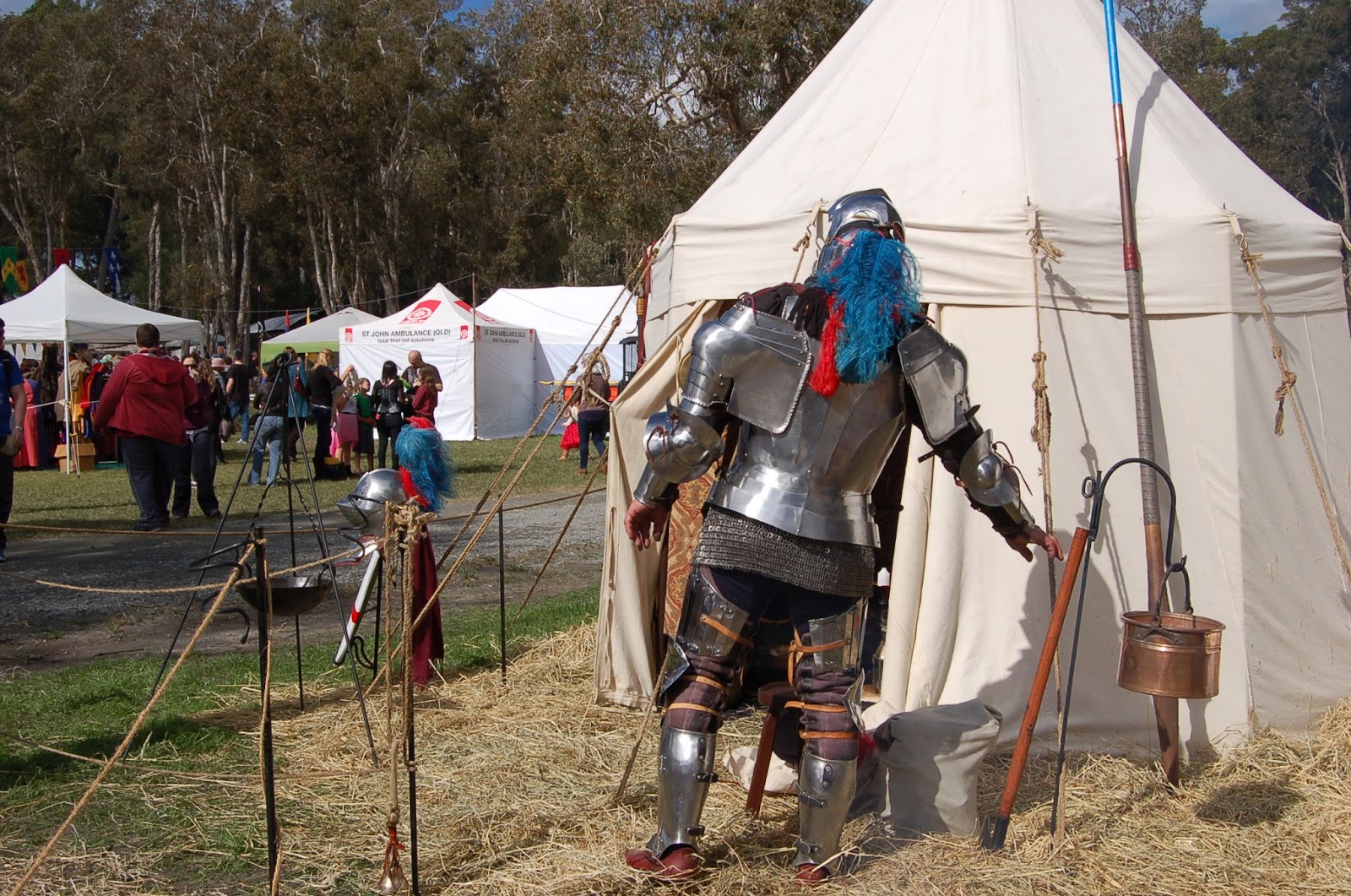
A few weekends ago, I made the annual trip out to the Abbey Medieval Festival with my re-enactment group RIFF (Re-enacting Independently For Fun). Due to other commitments I was only able to make it for one day of the event, but I had a great time at any rate. We were set up in a bit of different spot this year than in the past, however still part of a 15th Century village set up. We didn’t get as many people stopping by as we expected mainly because we were outside of previous grounds, tucked along beside the road. I don’t think people even realised that we were there.
But we certainly tried to provide the ambience of the period. Aside from our encampment and costumes, we provided talks on dressing a 15th Century woman, dressing a 15th Century man and dressing a 15th Century soldier. I also spent a lot of my day working on various forms of women’s handiwork including fingerlooping and lucite braiding to make lacing cord for my costumes. We also put on quite the spread at lunchtime where we all provided a dish to share. My contribution was mini pies – I made pork and veal pies and apple pies. They certainly went down rather well.
And for the event, I made myself a new kirtle. My old one no longer fits thanks to cake, so I really needed a new one. And this time, I changed it up by adding short sleeves. I have always loved the short sleeve kirtle look so it was a nice change to my flat front kirtle. If you’re looking for a pattern, mine is drafted up from the Medieval Tailor’s Assistant. It is very comfortable and supportive through the bust as it is designed to be tightly laced at the underarm. And I had learnt from my previous gown and changed up the lacing direction to make it a bit easier to get on and off. Unfortunately I didn’t quite get it finished and had to resort to machine stitched eyelets, but that will be rectified in time for next year. I of course topped it off with my Burgundian robe and horned headdress. I’d love to make a new Burgundian out of a silk brocade and trimmed in fur but I just couldn’t afford the fabric this year. Maybe I can aim towards making that component for next year.
Showing posts with label 15th Century. Show all posts
Sunday, August 2, 2015
Wednesday, July 16, 2014
The Three Hose
On Sunday I attended the annual Abbey Medieval Festival with my re-enactment group RIFF. We again attended as a group of 15th Century fabric and clothing merchants under the banner "The Three Hose". My group was there for the entire weekend, however I only had costume enough to attend one day. As it is, I was unable to wear my flat front kirtle as it seems to have shrunk in my wardrobe. Thankfully my Burgundian robe is loose fitting and my earlier period kirtle still fit. I got to wear my horned headdress again, and this time I remembered to bring along my hemmed veil. I also bought a lovely 15th Century style necklace to finish off my ensemble.
It was quite the relaxing day. We were set up and ready for when the public arrived, before lining up for the opening parade ceremony. I stayed busy for the day by practicing my finger looping (a medieval method for creating lacing cords). I only know the one design (a 5 loop design), but at least it is pretty and in the end I end up with a pretty lacing cord that is actually useful for my costumes and stands the test of time. As for out encampment...
Tuesday, July 9, 2013
Saturday at Abbeystowe
What an weekend. On Saturday, I attended the Abbey Medieval Festival for the first time as a re-enactor. Originally I had planned to be there for the whole weekend, but sickness got in the way and my body was just not up to handling two full days out. I spent Friday evening throwing together everything I needed and packing my car – ready to be up early to get out to Abbey and set up. I rose on Saturday morning at 5.30 (urgh), dressed in my 15th Century gown to the best of my ability and got on the road. It’s not an easy task dressing in a tight side lacing kirtle by yourself, especially when the eyelets are a bit too tight for the lacing aglets. At any rate, I arrived on site just after 6.30am, unloaded my car and got into setting up my shade and table (after having one of my fellow re-enactors lace up my kirtle). We got the site all set up in no time and had enough time before the public arrived for a touch of shopping and purchasing food.
I knew right off the hat that it was going to be one of those days. First, I realised that I had left the belt for my gown at home (it needs a belt to fit properly). Then I realised that the handkerchief linen veil I had spent hours hemming, was ironed and neatly folded on the dining table at home. Finally, the role of linen I was going to bring for display was also left on the couch at home. I persevered though. In the end, I bought a belt from one of the stalls and I had thankfully taken the leftover fabric from my veil to display, so I tore off another strip and just used it as an unhemmed veil.
As for my costume, while I didn’t get my smock made in time (I just used a long chemise from another outfit), I did get the headdress complete to wear and thankfully had the green kirtle and blue Burgundian gown that I had made a few years back that I was able to wear. I really like how the horns that I made finished off the outfit and balanced out my outfit. I was disappointed with the headwrap I had to wear last time I used the outfit, so the horned headdress was a blessing. I made them up out of the book “The Medieval Tailor’s Assistant”, so it really made for a simply pattern drafting process. The veil really completes the look well.
My other new thing for the day was my first attempt at a medieval pork pie. I had found a few recipes on-line and decided to try my hand. So, to be the helpful little fiend that I am, here is what I did (with a few adjustments so that it will be better next time). Please be aware that my pastry recipe is not one from the period – I wanted it to be nice and edible. Many medieval pie pastries were quite thick and sometimes inedible as something simply to preserve your meat in.
Ingredients:
600g – 800g pork steak
1 cup beef stock
1 cup red / white wine
2 Tablespoons Honey (omit if you are using a sweet wine)
2 Tablespoons Gravy Powder
1 tsp gelatine (to help the pie set properly)
½ cup diced dates
½ cup raisins
4 Tablespoons fresh grated Ginger
Cornflour to thicken
Pastry:
2 cups plain flour
2 cups self raising flour
120g butter
60ml water
22cm spring form pan
Method
Dice your pork into small pieces and put in a saucepan with a little oil to brown slightly. Add the beef stock, wine and honey and bring to the boil. Simmer for 20 – 40 minutes (will help soften the meat). Add gravy powder and gelatine. Add enough cornflour to thicken your mixture enough to satisfy – you want the innards of your pie to hold together when cool. Allow the mixture to cool. Meanwhile make your pastry. Mix the flours together. Rub the butter through with the tips of your fingers. Add water and mix into a dough (you may need more water to get it to come together). Roll mixture into a ball, cover in cling film and place in the fridge for 30 minutes. Line the bottom of your springform pan with baking paper and heat your oven to 180 degrees Celsius (moderate). Roll out 2/3 of your pastry on a lightly floured bench and place into the springform pan as the base. Stir the diced dates, raisins and ginger into your meat mixture and pour into the pastry. Roll out the remaining pastry and place on top as the lid of your pie. Trim off the excess pastry leaving a 2cm edge. Roll the edges in to seal the pastry. Cut a few slits in the pie lid for steam to escape. Bake for 30 – 40 minutes. You can either serve it hot or allow the pie to cool before refrigerating. We ate mine cold the next day, and it was lovely.
All in all though, I had a lovely day at Abbey and find that I much prefer to be a re-enactor there than a member of the public. In the end, I did shop a bit, and bought a few re-enactment supplies – a pottery cup and bowl, a wooden plate, dress pins, 3 brooches and a couple of belts. Not sure I want to be sleeping out there though next year – it’s very dirty and cold, and I love a hot shower and my waterbed too much to give that up. Let’s just hope that I am not horribly sick with a lovely sinus infection next year.
I knew right off the hat that it was going to be one of those days. First, I realised that I had left the belt for my gown at home (it needs a belt to fit properly). Then I realised that the handkerchief linen veil I had spent hours hemming, was ironed and neatly folded on the dining table at home. Finally, the role of linen I was going to bring for display was also left on the couch at home. I persevered though. In the end, I bought a belt from one of the stalls and I had thankfully taken the leftover fabric from my veil to display, so I tore off another strip and just used it as an unhemmed veil.
As for my costume, while I didn’t get my smock made in time (I just used a long chemise from another outfit), I did get the headdress complete to wear and thankfully had the green kirtle and blue Burgundian gown that I had made a few years back that I was able to wear. I really like how the horns that I made finished off the outfit and balanced out my outfit. I was disappointed with the headwrap I had to wear last time I used the outfit, so the horned headdress was a blessing. I made them up out of the book “The Medieval Tailor’s Assistant”, so it really made for a simply pattern drafting process. The veil really completes the look well.
My other new thing for the day was my first attempt at a medieval pork pie. I had found a few recipes on-line and decided to try my hand. So, to be the helpful little fiend that I am, here is what I did (with a few adjustments so that it will be better next time). Please be aware that my pastry recipe is not one from the period – I wanted it to be nice and edible. Many medieval pie pastries were quite thick and sometimes inedible as something simply to preserve your meat in.
Ingredients:
600g – 800g pork steak
1 cup beef stock
1 cup red / white wine
2 Tablespoons Honey (omit if you are using a sweet wine)
2 Tablespoons Gravy Powder
1 tsp gelatine (to help the pie set properly)
½ cup diced dates
½ cup raisins
4 Tablespoons fresh grated Ginger
Cornflour to thicken
Pastry:
2 cups plain flour
2 cups self raising flour
120g butter
60ml water
22cm spring form pan
Method
Dice your pork into small pieces and put in a saucepan with a little oil to brown slightly. Add the beef stock, wine and honey and bring to the boil. Simmer for 20 – 40 minutes (will help soften the meat). Add gravy powder and gelatine. Add enough cornflour to thicken your mixture enough to satisfy – you want the innards of your pie to hold together when cool. Allow the mixture to cool. Meanwhile make your pastry. Mix the flours together. Rub the butter through with the tips of your fingers. Add water and mix into a dough (you may need more water to get it to come together). Roll mixture into a ball, cover in cling film and place in the fridge for 30 minutes. Line the bottom of your springform pan with baking paper and heat your oven to 180 degrees Celsius (moderate). Roll out 2/3 of your pastry on a lightly floured bench and place into the springform pan as the base. Stir the diced dates, raisins and ginger into your meat mixture and pour into the pastry. Roll out the remaining pastry and place on top as the lid of your pie. Trim off the excess pastry leaving a 2cm edge. Roll the edges in to seal the pastry. Cut a few slits in the pie lid for steam to escape. Bake for 30 – 40 minutes. You can either serve it hot or allow the pie to cool before refrigerating. We ate mine cold the next day, and it was lovely.
All in all though, I had a lovely day at Abbey and find that I much prefer to be a re-enactor there than a member of the public. In the end, I did shop a bit, and bought a few re-enactment supplies – a pottery cup and bowl, a wooden plate, dress pins, 3 brooches and a couple of belts. Not sure I want to be sleeping out there though next year – it’s very dirty and cold, and I love a hot shower and my waterbed too much to give that up. Let’s just hope that I am not horribly sick with a lovely sinus infection next year.
Subscribe to:
Posts (Atom)